

Hello fellow engineers, welcome to the eighth issue of The Main Thread, wrapping up insights from “Caches Lie: Consistency Isn’t Free”. Over the past issues, we have built from patterns and memory basics to grappling with inconsistency’s roots and remedies. Now, we elevate to advanced techniques that scale caches globally, introduce a framework for budgeting divergence as rigorously as you would latency, and tackle the operational grit of keeping everything humming in production. This isn’t about quick fixes - it’s about transforming caches from fragile accelerators into resilient cornerstones of your architecture.
In large scale systems, caching evolves from a simple layer to a distributed beast demanding foresight and discipline. We will go through these with clear explanations, code to experiment with, and strategies learned from high-stake environments. If you have ever faced a cached meltdown during peak traffic or wondered how to align technical trade-offs with business realities, this issue is your playbook.
Let’s finish strong.
Scaling Caches for Big Leagues
As your system grows, basic patterns give way to sophisticated setups that handle cold starts, layered success, and global reach. Cache warming addresses the “cold start“ curse (new deployments start with empty cache, causing initial latency surges as everything misses). Proactively populate key data before routing traffic, focusing on essentials like sessions or configs to smooth the ramp-up.
Multi-level hierarchies add depth: stack caches in tiers, with L1 (local, ultra-fast), feeding into L2 (distributed, shared) and beyond to persistent stores. Hot items bubble upto faster layers, while cold ones demote, optimizing for both speed and cost. In global apps - geographic distribution is the keys - replicate caches across regions but manage cross-continent invalidations. Opt for eventual consistency for speed (accept brief replication lags) or strong guarantees if uniformity is paramount, perhaps via pub/sub for propagation.
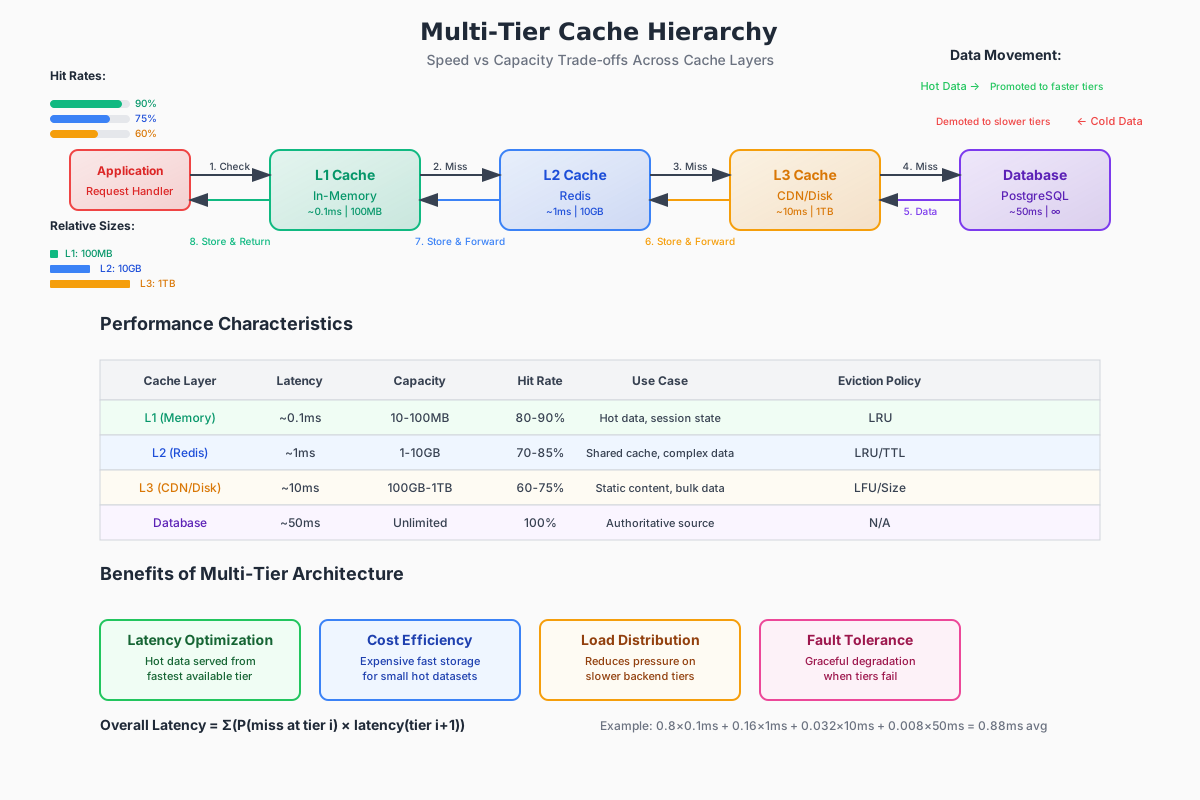
Here’s a quick async warmer in Python to preload critical keys, adaptable for your setup:
import asyncio

async def warm_critical_data(cache, database):
    critical_keys = ["sessions:active", "configs:global", "profiles:hot"]
    for key in critical_keys:
        try:
            value = await database.get(key)
            await cache.set(key, value)
            print(f"Warmed key: {key}")
        except Exception as e:
            print(f"Warm failed for {key}: {e}")

# Run it pre-traffic: asyncio.run(warm_critical_data(my_cache, my_db))
These patterns demand monitoring but pay dividends in reliability at scale.
Turning Divergence into a Managed Metric
Inconsistency is not a bug to eradicate - it’s a cost to budget, much like you would setup SLOs for uptime. Start by documenting per-feature tolerances: for a profile page, 5 seconds of staleness might be fine (low user impact) but for balance, we can tolerate NO staleness (high revenue impact). Get stakeholders buy-in with rationales tied to revenue and/or UX.
To effectively manage inconsistency, begin by measuring key inputs:
u → update rate → changes per second
r → read demand
T → stale window
A straightforward model can then estimate the exposure with the formula
expected_stale_friction ≈ min(1, u × T)
If this calculated fraction surpasses you predefined budget, you can adjust by pulling several levers, such as reducing T through synchronous invalidations, batching writes to decrease u, routing critical reads directly to the backing store, or relaxing the budget itself while implementing additional monitoring or reconciliation safeguards.
To put this into practice, operationalize inconsistency as SLIs and SLOs: sample a small fraction of reads (typically 0.1-1%) to calculate staleness ratios, set up alerts for any breaches, and create dashboards segmented by feature or region for quick insights.
Here's a Python monitor class to track and alert on these budgets:
import random
import time
from dataclasses import dataclass

@dataclass
class StalenessConfig:
    feature: str
    max_staleness: float
    sample_rate: float
    slo_threshold: float

class StalenessMonitor:
    def __init__(self):
        self.configs = {}
        self.metrics = {}

    def register(self, config):
        self.configs[config.feature] = config
        self.metrics[config.feature] = {"total": 0, "stale": 0, "violations": 0}

    def check(self, feature, cache_val, auth_val):
        config = self.configs.get(feature)
        if not config or random.random() > config.sample_rate:
            return False
        m = self.metrics[feature]
        m["total"] += 1
        staleness = auth_val.get("ts", time.time()) - cache_val.get("ts", 0)
        is_stale = staleness > config.max_staleness
        if is_stale: m["stale"] += 1
        if m["total"] > 0 and (m["stale"] / m["total"]) > config.slo_threshold:
            m["violations"] += 1
            print(f"ALERT: {feature} SLO violated!")
        return is_stale

# Example
monitor = StalenessMonitor()
monitor.register(StalenessConfig("balance", 1.0, 0.1, 0.01))
# In reads: monitor.check("balance", cache_data, db_data)
Debugging, Planning, and Recovery
In the wild, caches face chaos. Debugging requires tracing hits/misses, invalidation paths, TTL behaviours, and hot keys.
Capacity planning watches memory (under 80% to prevent thrashing), trending hit rates, evictions, and latency spikes.
For disasters, design graceful degradation: fallback to direct DB reads, prioritize warming vital data, throttle rebuilds to spare the backend, and monitor the progress.
Users should experience slowdowns, not outages - build that resilience in.
Mastering the Art of Caching
Caches accelerate but demand earned consistency. With these advanced tools, budgets, and ops practices, you're equipped to build systems that are fast, reliable, and scalable. If this series sparked redesigns or aha moments, that's the win.
What's one caching lesson you'll apply next? Reply and your feedback shapes what's coming.
Thanks for joining the thread. Namaste,
Anirudh
P.S. Full code in Cache Mechanics repo—contribute if inspired.

